Create, Eat, Think Roundup – Fuel Your Creativity!
Create
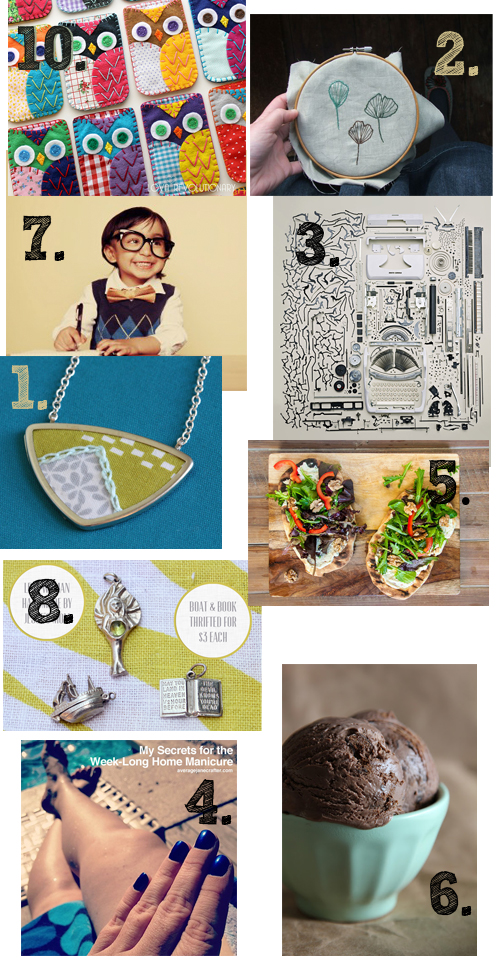
1. Beautiful Fabric Pendant - I can just imagine a little fabric leftover being used for this.
Read more →
1. Beautiful Fabric Pendant - I can just imagine a little fabric leftover being used for this.
Read more →
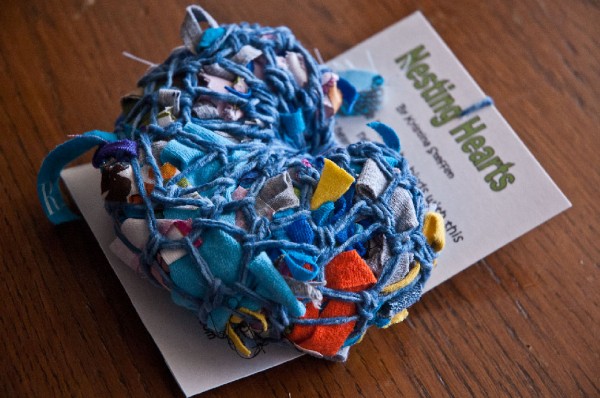
My local friend Tina (aka Kaotic Krafter) brought these great nesting hearts to this month’s Ames C.art meet up. When she first pulled them out and was like “look what I made”, I was all “ohh, that’s nice”. I had no clue what it was and was trying to be as polite as possible that I thought it looked like a pile of scraps in netting.
Then she explained, “It’s a nesting ball! As in for bird nests!” The light bulb went on and I immediately saw it’s beauty and brilliance. Ha! I felt like a double jack *ss. Especially because I had wrote about leaving scraps for birds in a little article about using up fabric bits for the Craft Leftovers Zine. I swear, I should remember these things.
Anyway, this was perfect timing because after that quilted pot holder tutorial my little scrap bin was getting too full and spring is oh so close to being here. I’ve decided to whip up a bunch with the crochet version – dealing two blows to the scrap pile! My kind of project. I’ll update the post with pics of my project when it’s done. She was nice enough to gift me the one you see here.
A whole bunch of these little guys are going in the ArtVend later this week.
You can learn how to make your own Nesting Ball using a potato sack OR crocheted netting over on Kaotic Krafter’s blog.

Thanks Tina for turning the light bulb on!
Happy Crafting!
Kristin
Since we purchased our first piece of grown up furniture I’ve really been wanting to make some pillows for it. Dashes of colors, coziness, and diy goodness.
Now that I’ve finished the daybed too, we are in dire need of some extra piles of cozy around here. And I have a ton of fabric to use up from the wedding, which is perfect for backing all kinds of fun pillow projects.
I know I’ve posted before about using pre-made forms vs making your own vs just
using stuffing – Pillow Punch Out Part 1 and Part 2. Which after reading those posts makes me realize I’ve been crabbing about not having enough pillows for not just 6 months, but more like 2 years!
Enough! Pillows need to be made! I dug my sewing machine out from underneath the rubble of wedding aftermath and finally made my first pillow, this pillow.
I wanted to show you some of the really fun pillow projects I found that inspired me to finally clear a sewing space and get started on nesting a cozy pile of pillows on my couch.
On Martha Stewart – She is some kind of Pillow Making Goddess – 24 inspiring pillow making ideas.
Uh oh, More pillows here I come! I already have four more mapped out with the fabric shown above. I’ll be posting patterns for each one after I get back from Texas.
Happy Craft Leftovers!
Kristin Roach
C.L. Tice is a writer, poet, crafter, and mom. Her writing and creating adventures are inspired by the world around her. She can be found at her blog, Mused.
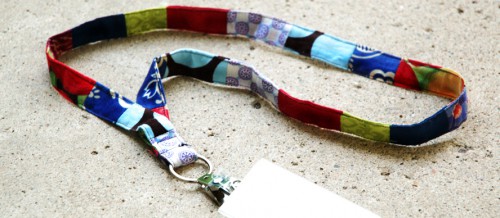
Recently, my workplace changed to having swipe card access rather than the punch codes we had been using. We’ve never required ID badges for employees and I’ve never worked anywhere where we had badges or cards. So this is a new experience for me.
If it was only the door to get into the building, it wouldn’t be much of a problem and I would leave my card in my work bag. But, to get to the restrooms and common area, there is another locked door. I can see myself forgetting my card and getting locked out. It’s not like I can put the card in my phone like I did the numbers.
I thought a good solution might be a lanyard that everyone else seems to like so well. They give them out everywhere – parades, fairs, promotional tables. But wouldn’t you know, the only one I had in my house when I went looking was the one my son uses for his key.
What is a crafter supposed to do?
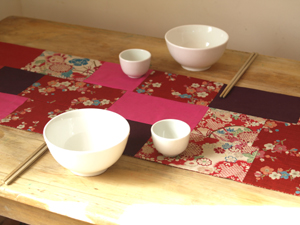
My sister came over earlier in the day and went through my stash of fabric so I had a pile of scraps right on top. With the sewing machine already threaded from an ealier project, piecing them together didn’t take much time at all. The most time consuming part was picking out the fabrics – and at one point I decided it didn’t matter if they really matched. It is patchwork after all and should
I cut the strips to 3” wide and between 1” and 2.5” long based on what I had for scrap. I cut three pieces of each fabric and ironed them.
Once they were sewn together, I ironed the seams flat and folded the long piece in half. Then, I opened it up and folded each side in to the middle point and ironed again. Folding it back up, I sewed along both edges.
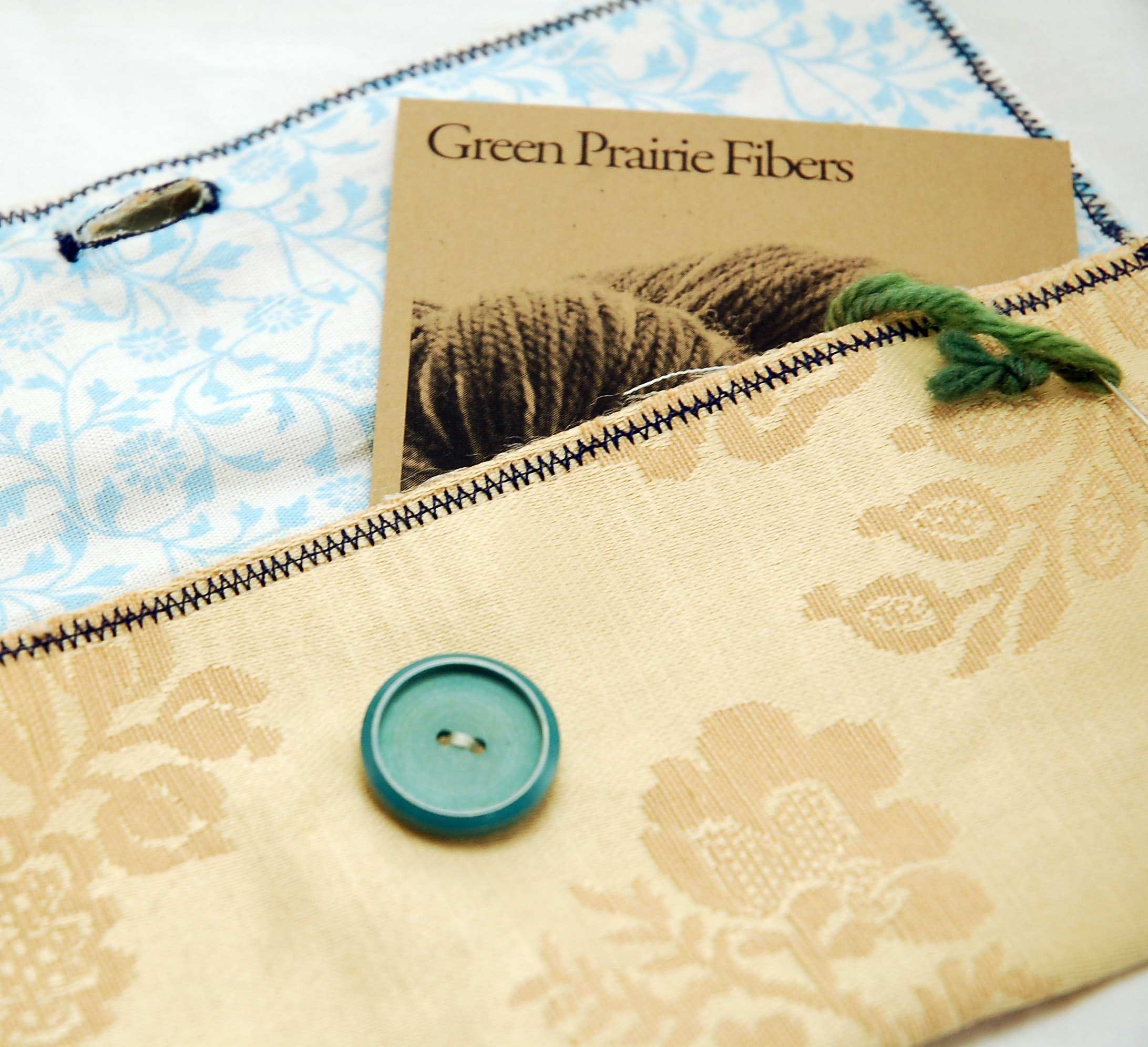
I didn’t have any D rings in my house but I did find a key ring and re-purposed it for my lanyard. Putting the ends of the length together, I slipped the ring onto the fabric. I folded up the end about half an inch and then another inch, settling the ring into place and sewing the fabric to itself.
Tadaa! I now have a nifty, and one of a kind, work accessory.
Happy Crafting!
++++++++++++++++
If you would like to contribute a guest post to Craft Leftovers, click here for all the details.


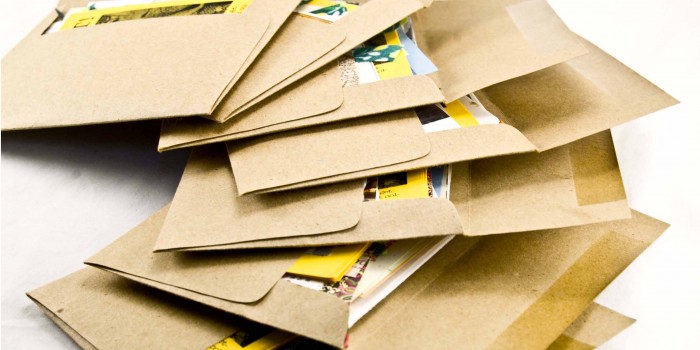
I love this little kit and it’s been out of stock for far too long. I get to dig around in my box of favorite paper scraps and collect up a series of patterns, text, and pictures to inspire both you and me to play with collage. The pictured kit is an approximation of what you will receive. Each kit is unique but are made in batches so contain the same style and amount of papers shown. For me, it’s always a treat to put together and to read about and see what you come up with.

You get a whole bunch of scraps of this and that: maps, sheet music, calendars, vintage magazines, photo copies from old books, vintage book pages, scrap book paper, graph paper, lab paper. And of course I include a piece of mat board if you want to make your collage as a post card or some other art paper for hanging on the wall or mounting.
I first made this kit to go along with last year’s July issue of Craft Leftovers Monthly. It was all about zine making and collage fit the topic perfectly. The instructions for the minizine were originally in the May issue–which is all about sending things in the mail.
::The Details::
Kit Includes everything you need to make your own collage (or two!):
Collage IT! Mini Zine
1 – 4×5.5″ piece of mat board to use as a post card
1 – 4×5.5″ piece of drawing paper for a collage base
Many many scraps of patterned and vintage pieces of paper.
This particular batch includes pieces of maps, sheet music, vintage magazines, and copies of victorian ladies.
Have you made a collage from the Collage IT kit? Add it to the Craft Leftovers Flickr Group!

Happy crafting!
Kristin
Last week I talked about what the zine contains, Monday covered how I come up with content each month. And today I’m going to go over the nuts and bolts of how these ideas make their way onto the printed page and get to your mailbox.
After I have all my lists, I start working through them. Contributors send me their articles around the first of the month, so their work has been proofed already. I write the articles I’ve mapped out and send them over to my friend Linda who copy edits all of it. She’s really great, like Karen, she’s volunteered her time to help me not sound like an idiot.

(patchwork book cover pictured above is just one of the fun scrappy patterns in this issue)
If I’m on schedule, I will have made all the projects for the zine before that to do list even gets made. Usually it’s a matter of converting my notes and sketches into something comprehensible. Those get sent off to Linda for copy editing too. When I get them back, I do some tech edits with fresh eyes. You know, making sure the math is right and double checking my measurements.

(Cute little owl that inspired the cover is also included in this month’s zine)
I use InDesign CS4 to layout the zine. It was difficult getting used to since I learned Quark first. After a few years of using it, loads of tutorials, and this book, I’m finally comfortable with it.
All the nicely edited text is dropped into InDesign just like I laid out in the paper mock up. This helps me figure out how long each article will be, and to see where I need to slim down. I often have to drop a pattern or add an article at this point.
Save. Print. I make a note in the new proof of where I want illustrations to go, what they need to convey, and what their dimensions should be. A lot of the time I end up doing some rough sketches directly on the zine proof.
Then the really fun part starts. Sure, I like writing, if I didn’t I wouldn’t have a blog. That’s the thing, I like writing but I love drawing.
I documented my process for making this month’s cover, so that’s what I’ll show you. It’s pretty much the same process for each illustration.
For the cover, I marked out the size it needs to be (5×7″) using a 3H pencil and taped it off with low adhesive archival tape.

I’ve been more adventurous lately and decided to collage a bit of fabric into my illustrations for the zine, especially the cover. Then I drew the main component–that super cute little owl.
I clean up the lines with an eraser and go over it with a fine tipped black marker.
Then it switches over to working on the computer. Depending on the illustration I’ll use a combination of Photoshop and Illustrator. I draw using an Intuos4 Wacom tablet. I have the sketch and regular stylus. For the cover, I opted to just use Photoshop.

Note: I tend to use Illustrator for drawings that need a bit more precision. I do the line drawings in Illustrator and then add color using Photoshop.
First I convert it all to Black and White using the image editing options. After that I convert it to gray scale. I’ve found that just converting to gray scale isn’t as flexible.

I create a new layer and remove any unwanted elements of the scan.
For the cover I drop in the text so I know what to draw around. You can see here the placement on that piece of fabric is pretty bad. I copy it to it’s own layer and change the opacity so it’s a lighter shade of gray and the text pops.

In another layer, I draw over my lines with the brush tool.
Another layer below that and I add color. Sometimes I scan fabric and add that in too.

Add a few more lines and I’m finished. Well, not quite, there was a lot of pushing a pulling that happened. I tend to do a few test prints to see if the gray on my screen is anywhere close to the printed version. Nope. It’s a lot darker, so back to the computer to lighten things up and darken others.

Finally I add it to the cover InDesign file, save it as a pdf and off I go.
I print the zine guts on my own printer, but the cover has to be printed at the local print shop. My printer doesn’t get hot enough to properly fuse the toner to the recycled grocery bag type paper and it rubs off pretty easily.

Back to the studio: I print the guts of the zine on my own printer. I use this really amazing paper that’s a little thicker than regular paper, but a little thinner than card stock. It’s 100% recycled and just slightly off white.
Now I become a one person assembly line. I put on an audio book or some of my favorite podcasts, grab my long arm stapler, and get to work. I staple, fold, and do the final trimming.

Somewhere in all this mess of writing, illustrating, and assembly, I’ll get a bit burnt out and need a break. So I turn to another task–postage printing.
I print postage on these mailing labels from Uline using Endicia for Mac. The envelopes I use are the same paper as the cover card stock–100% recycled and that lovely grocery bag texture.
Each zine gets packaged up in an envelope, postage slapped on, and I drop off a huge bag of packages to the post office.
I use X-Cart for the Craft Leftovers shop and also sell the zines on Etsy. I’ve opted to add the July issue to the shop even though I’m waiting on the covers. The only printer that prints it right (so the toner won’t smear) is down. They usually get things fixed pretty quickly so it shouldn’t be long at all. Since you will have to wait a little bit before it gets to you, you get a pre-sale bonus! And unlike last time, the turn around will be a lot shorter. I’ll find a solution and get it out the door by Monday no problem. Maybe even Saturday if all goes well.

or, if you know you want July and many more months, a subscription is the best way to go.
You save a significant amount over single issues, even with the pre-sale pricing. Subscriptions for Volume 4 coming soon to the shop!
Happy crafting!
Kristin
This past Saturday my friend Crystal passed on what she called a “craft leftover” from the 70′s craft book. It’s such perfect timing since the July issue of Craft Leftovers Monthly is about using fabric scraps.
This short book of just 132 pages is stuffed with whimsical patterns, advice, and tips on using up your fabric leftovers. A Farm Journal Craft Book: More Scrap Saver’s Stitchery by Sandra Lounsbury Foose is the second in a series of “Scrap Saver’s” books. Have any of you come across the first?

I had a really fun time reading this book cover to cover while recovering from a long outdoor adventure on Sunday. (I cycled 12 1/2 miles and gardened for 2 1/2 hours! So wonderful.) I started with the intro, which I’ve been reading more now that I have to write my own, and found it very enjoyable.
The general idea is that “you always have such a great source of inspiration right at your fingertips. The resources are all within your reach to create…” Which is so true! I love digging through my fabric and letting the project develop from the patterns and colors I find there. But, the idea of having an attic full of boxes of scraps, all color coded as described in the introduction is pretty daunting.
While the focus of CraftLeftovers.com is 100% on using up leftovers just like this book, it’s also about not acquiring more unless I really “need” it. I agree with about 95% of the book’s ideas, but the one about keeping a giant-never-to-be-used-in-a-lifetime-sized-stash, not so much.
The majority of the book is made up of these really fun true to 1970′s craft patterns, like these cover up kitties:
And there were a few that I absolutely fell in love with. Like these cute little pot holders.
My favorite were the salt and pepper shakers.
I always enjoy journeys into the world of vintage craft books and this one was particularly sweet. I hope you have enjoyed it too!
Happy scrap crafting!
Kristin
Today’s project is brought to you by the creative force behind Poppy Chic Designs, Taryn Sisco. Make sure to check out her super fun items in her etsy shop and on her blog.

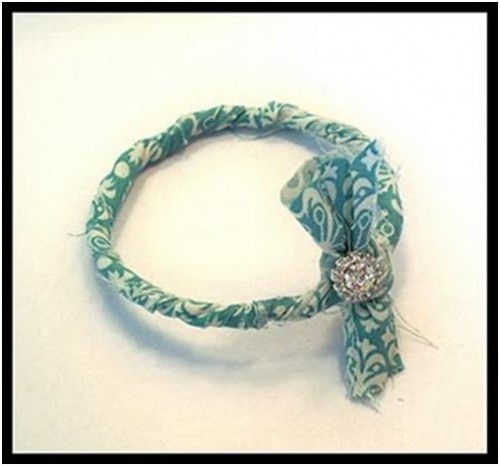
My first tutorial is here! These cute little bracelets are super sweet and fun to make too. Whenever I wear one people always ask where I got it… well now you know!
Materials
Some scrap fabric, 2”x18”
Metal bangle (thin)
A little sparkly button with a shank
Scissors
Hot glue gun or fabric glue

Instructions
Step 1: To start wrapping your bangle, leave about 2 inches as your starter. Then neatly wrap the fabric around the bangle.


Step 2: Keep wrapping the bangle, giving a little “tug” every once in a while to tighten the wrap.

Step 3: Tie the remaining fabric in a secure double knot and even up the edges.

Step 4: Use a hot glue gun or fabric glue to put a drop of glue into the crevice of the knot (this is where the shank of the button will push into).

Step 5: Add your sparkly button and hold it in place for a few seconds… and YOU’RE DONE!

Tips: Play around with different fabrics. You can make them a bit longer (2”x26”) to tie a bow at the end too. Be creative, it’s a sweet thing!

Author’s Bio: While working as a showgirl for Carnival Cruise Lines in the 1990s, Poppy Chic Designs creator Taryn Sisco would also help out as a seamstress for the costumes and accessories. A decade later the former showgirl turned crafty mom decided to take her love of accessories to the next level and focused on starting her own line of girly goodies. Always inspired by vintage style pin-up girls, and the fabulous styles of the 1920s through 1950s, Taryn created Poppy Chic Designs! A line of boutique style flower hair accessories and unique jewelry with a retro flair designed for moms, teens, and little girly girls. From sweet layered flower hair clips to big bold fabric corsages, tiny blossoming flower earrings to fabulous vintage bloom cocktail rings, each piece is handcrafted using a mix of amazing new and vintage fabrics, lace, tulle, rhinestones, pearls and of course love!

I have a bin that’s specifically for leftover yarn and over the last few months I’ve been slipping a little bit of this and that in and out of it. When I went to find a particular ball of yarn a few weeks ago, I found that this was the result of my “slipping in and out.” Wow. I was a little overwhelmed to say the least.
I decided it needed to end right then and there. I put on a movie…and then another. I proceeded to untangling one of the biggest tangles I have dealt with in quite some time. I would equate it to the epic untangling of the Sale Crib at the Yarn Exchange some three years ago.
Anyway, it got me to thinking that part of using your leftover yarn is keeping it sorted (and untangled) and I should tell you how I keep mine from turning into a big mess like this – as long as I follow the guidelines I set for myself.
1. Untangle it.
There can be no organization until you have things untangled. There are a few tips I’ve learned from working at yarn shops to help make untangling less of a chore.
+ Never keep pulling once you feel a strand tightening up.
+ Tease out a clump of tangled mess before trying to pull on any one particular strand.
+ Follow one strand of yarn at a time and wind it up as you go along.

2. Wind the yarn as you untangle. Trust me. If you don’t, you will have untangle the now loose pile of yarn. I like winding my yarn into little balls, but if there is just a few yards I use the butterfly bobbin method. I wrote up a tutorial for how to make a butterfly bobbin a few summers ago that you can check out if you don’t know how. It’s pretty handy.

3. Keep it all straight. If you put your yarn into a bin loose, the picture above will soon be it’s state of being. I keep my yarn leftovers organized by weight and fiber type.
Will you check that out? That is all the leftover yarn I have left in my stash! Can you believe it! Awesome! Just a half bin full.
When I started up Craft Leftovers, I had 3 garbage bags and quite a few bins of leftover yarn.
I think it’s time to make some more dishcloths and stash socks.
Happy Crafting!
Kristin Roach

I’m excited about this project. It’s such a great way to use up scraps – this whole pile was from my “end run” type pieces. And then there is also the fact that it’s the first push towards re-doing the living room area… one area I have yet to tackle. Next step, slip cover! Well… maybe… not exactly a “craft leftovers” project because I’m going to go ahead and just order the fabric for it (slip covers are huge). In the spirit of redress, I thought it might be a project that you would be interested in reading about. And posting about it will help me to keep checking in with you and finish it. But for this week, I’m checking in on the pillow project!
Unfortunately a lot of my fabric scraps wouldn’t go the full length of my pillow forms. I think the best way to convert all these scraps into a large pillow is to weave the fabric strip into 2 panels, then make them into larger, log cabin-style squares for the pillows.
Phase 1 of the woven pillows for the couch is finished up. I went through a bunch of fabric scraps and sliced them into 1/4″ – 1″ strips.
I took a big piece of cardboard and cut 1/4″ notches in it along both ends. I’ll warp it tomorrow with either some left over warp from my weaving or some #10 crochet thread. Then I’ll be all set to start weaving!
See you all soon!
Happy Crafting!
Kristin
:: Woven Scrap Pillow Part I :: Redress Flickr Pool ::
Winter is always the season of weaving for me. With my overly large floor room, it’s the only time of year that I’m okay being tucked into my basement studio for hours shuttling back and forth. I turn on the space heater, bring down a pot of tea and put it on my candle warmer. [...]

What people are saying